Win One for Who?
Next to the current president of the United States, the worst thing to happen in this young century is the professionalism of college sports. We know that some unethical programs have been figuring out ways to secretly pay athletes for years, but now it is wide open. In the past few weeks of the college football playoffs, it has become common for stories on the big matchups to mention how much money the star players are making. Thus, we know that Indiana's Heisman winning quarterback Fernando Mendoza, who came out of Miami’s Columbus High, is earning around $2 million, after turning down almost twice that from the University of Miami. Those big bucks came after he showed his ability at the University of California, where he reportedly got a measly $100,000. The quarterback he will face on the championship game against UM tonight, Carson Beck, also jumped ship from Georgia for an increase in compensation to an estimated $4 million. A stunning 65 percent of Indiana's starting lineup are transfers.
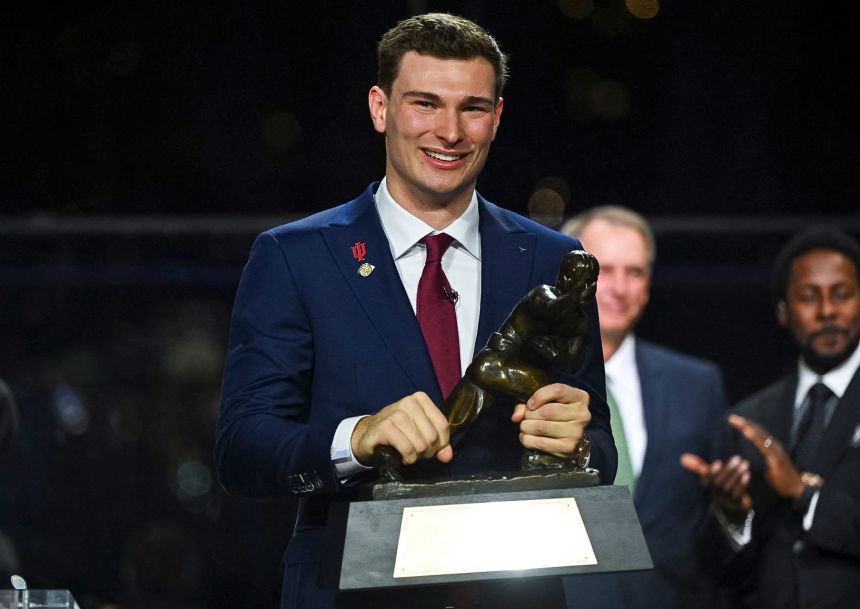
Fernando Mendoza holds the Heisman Trophy after his historic season.
It has reached the point where the average scale for various positions, both offense and defense, at big time teams is being published. Some players earn more money in college than they would likely get for turning pro. College athletics, once the essence of amateurism, have become a minor league for the pros. The justification for this sad situation is that college football has become a huge money-maker for schools; why not share that money with the players who make it happen?
The principal reason why not is that it is a perversion of college sports. For the few dozen top football schools that benefit from it, hundreds of smaller schools with modest football programs, or none at all, are being denied the opportunity to succeed against the big boys. And the whole concept of school spirit, the "win one for the Gipper" mentality, is being lost. How long are fans going to have an almost religious devotion to their alma mater, or hometown school, when players to whom they have become attached, routinely leave through the portal, and players they never heard of show up in their place, and may in turn chase money after one season? Consider Robert Morris whose recent NCAA basketball tournament team lost its entire starting team to the transfer portal. Or James Madison, whose coach took 14 of his players when he was hired to build the current Indiana powerhouse. Closer to home, our alma mater La Salle has a basketball tradition. Several national championships and three players of the year. Its great star Tom Gola, set a rebounding record that has stood for 70 years. But today, La Salle can't afford to pay for top talent, and each year its best players enter the transfer portal.
With famous coaching figures such as Nick Saban calling for reform, there is a growing sense that the present state of college sports cannot continue. There are various ideas to change it, so here is ours. Go back to the old days when a sports scholarship included tuition, room and board, and a stipend to help with other expenses. If players were wise, they would value their college degree (if they graduate) because if they can't make it as pros, which the great majority won't, their education could be the difference between a blue-color job and a white-collar opportunity that would make a comfortable life. Make it uniform for all schools, big or small. And if an incoming athlete wants to make more money, let him turn pro. Establish a minor league such as baseball, or to a lesser extent pro basketball. There are actually semi-pro football leagues, The players often have been cut by NFL teams and have full time jobs, and are looking for a second chance. And in a few cases, that happened. But there is no formal minor league as in baseball.
Our guess is the most promising high school athletes won't go for it. The enormous publicity that goes with being a college star can lead to a lucrative pro career. No such attention would be paid to a kid making money by playing for a team in Ocala, Florida or Norristown, PA. Making a minor league system that fans actually supported would be a big job, but the problem it might solve - the destruction of college sports - is even bigger. We need to return to the day when "win one the Gipper" means something.