Preserving The Day of Infamy
"A day which will live in infamy." Sunday was Dec. 7 and it was once described by a president of the United States in those memorable words. Any student of American history will instantly recognize the context, and most people who remember anything about World War II will as well. But we suspect the average college student will not. We say that because we found nothing in several newspapers or on television in reference the Dec. 7, 1941 and the Japanese attack on Pearl Harbor, an event which took what had been a conflict confined to Europe and made it world war - a war of such horror and death total that it ranks as one of the major events in recorded history, and certainly of American history.
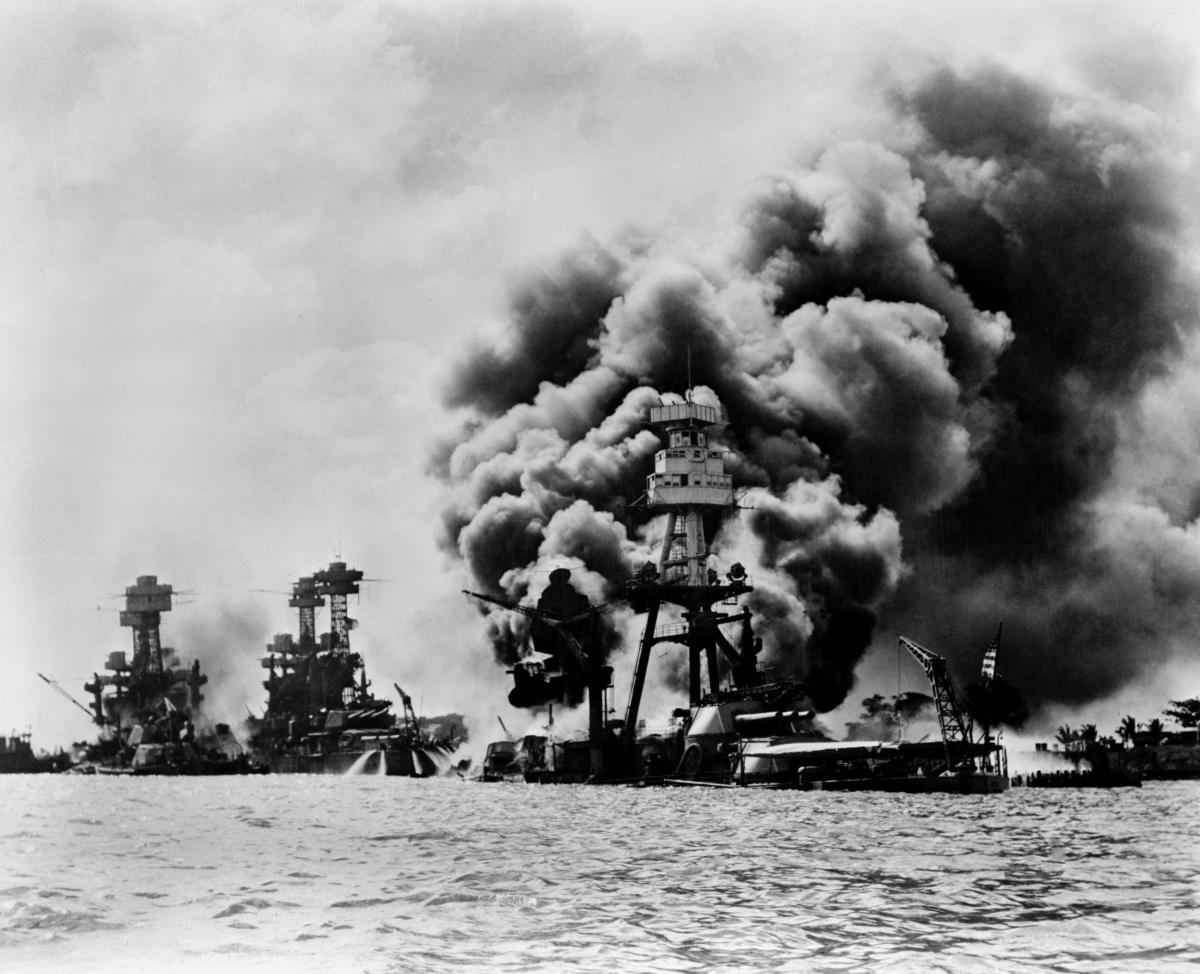
Three stricken U.S. battleships. Left to right: U.S.S. West Virginia, severely damaged; U.S.S. Tennessee, damaged; and U.S.S. Arizona, sunk, December 7, 1941
It shows that President Franklin Roosevelt's eloquent speech to Congress declaring war has not lived in infamy, although for years it was prominently noted in most media. But as the veterans of that war have passed on, the stories of their experiences have gradually slowed down. It is not a rare phenomenon. November 22, the date of John f. Kennedy's assassination, has similarly tended not to be remembered with the impact it had for years. 9/11 still is mentioned often, but give it a few years. It is the nature of things.
Pearl Harbor day was once almost a national holiday, and it seems that the date should be memorialized in some form - similar to how Sept. 15, 1940 still is commemorated as "Battle of Britain Day.” Few people alive today were directly impacted by Pearl Harbor day, but millions of families live with a history of its profound impact on the immediate ancestors. Our family was, and not just because our favorite cousin, Tommy McCormick, paid the supreme sacrifice. He was a college student when the war began but dropped out to train as a Navy pilot. He was a reconnaissance pilot who died at Iwo Jima in what years later appears to be a death by friendly fire from the ships he was spotting for.
Our own family suffered a consequence of that day as well. Our dad had been working for what was then Sears, Roebuck for 20 years. He was a plumbing and heating specialist for Sears pre-fab housing unit headquartered in New Jersey. It had once been a busy place; its houses were perfect for the depression years, enabling cash-strapped people to buy homes they could assemble themselves, but as the economy recovered, Sears decided to close that business. Dad managed to get a transfer to Elmira, New York, running the plumbing and heating department of its store there. He apparently did well. He was recognized in 1941 for his years of service. But then came Pearl Harbor. Mother wanted to return to be near her many relatives in Philadelphia, and Dad was able to get transferred back to Sears’ big facility in Philadelphia where had started out. He had barely settled in when he lost his job. In what now seems a serious miscalculation, Sears thought its business would suffer with so many customers joining the service. It decided to cut back on middle management personnel. Dad recalled that the executive charged with choosing whom to let go was a man he had started out with years before.
"I did not like him and never took pains to conceal it," Dad said. "He remembered." Dad was 50 years old with three young sons. He wound up in the insurance business, which he never much liked. He must have felt betrayed by life. Our family went from relative prosperity to living hand to mouth until we grew up and got out on our own. In a strange way, we were a casualty of Pearl Harbor.
We were wondering how to end this ramble, when Monday's Sun Sentinel arrived with a front page teaser leading to a lengthy article of exactly the kind we had not seen this year = a piece on the sparse turnout in Hawaii at the annual event remembering Pearl Harbor. No ancient veterans of that day were present, and their descendants determined to recall the Day of Infamy are dwindling in number.
The meaning of Dec. 7 has survived for another year.

where home was
This Comment had been Posted by tom mc gill
507 E Chelten Ave. I recall it very well. Merry Christmas my friend.